

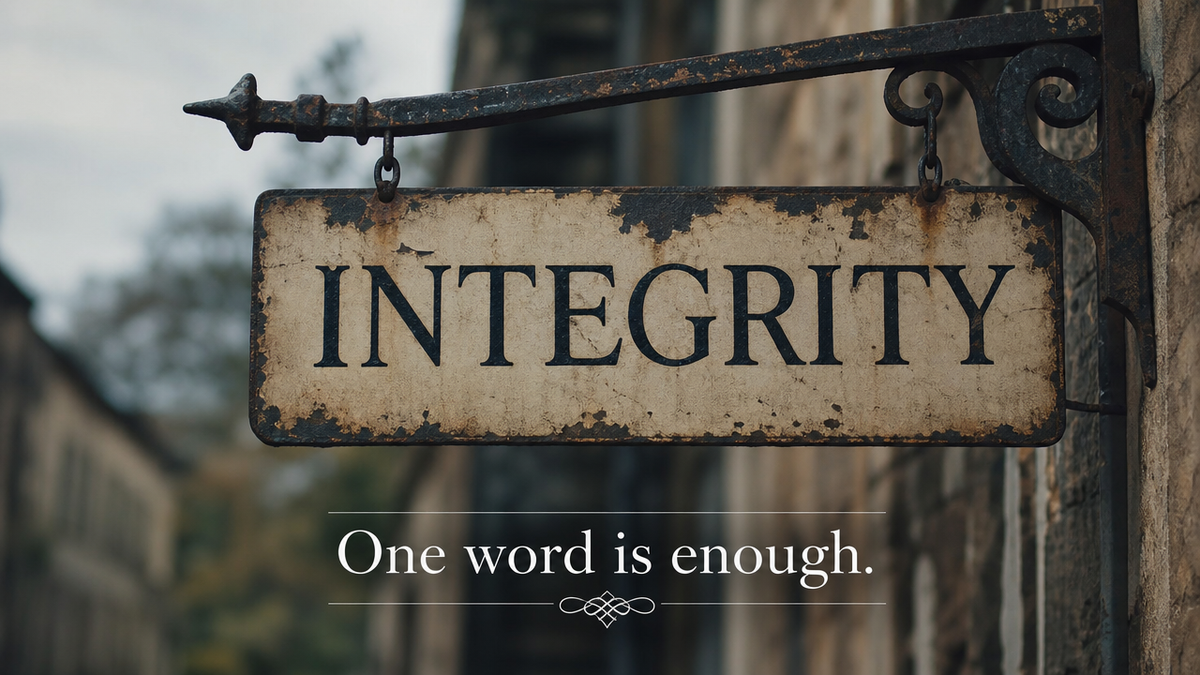
Our word, once given, does not need changing. It is the integrity that binds together our duty and our community — and, just as importantly, the quiet discipline of saying a thing once, and well.
Bushi ni Nigon wa Nai 武士に二言はない [pronounced “boo-shee nee nee-gon wah nye”] means, very literally, “the warrior does not speak twice.” It is a common Japanese expression, and at its heart it is about one thing: integrity.
The phrase is often rendered with bushi as “samurai,” but the word means warrior in the broadest sense. For us it points squarely at the karateka. The karateka keeps his word. He keeps his promise. His words do not have to change, because his words were honest the first time. To speak once, and to stand behind it, is the whole idea.
On its face this seems almost too obvious to need a name. From the time we are small children, our parents tell us to be honest. As we grow older, people speak of integrity. Of the many concepts we study in karatedō, a great number are, frankly, obvious — constant improvement, doing our best, and so on. Few people would argue against them. But it is precisely the obvious, foundational things that are hardest to live by, and most worth naming. Encapsulating an idea like bushi ni nigon wa nai 武士に二言はない helps us communicate it, train it, and — hardest of all — actually practice it.
What Integrity Really Means
Integrity has several facets, but fundamentally it is honesty: being honest about who you are, expressing who you are, and continuing to express who you are. In that sense it is bound up with identity itself. The karateka whose words can be relied upon is the same person today as yesterday, in the dojo and out of it.
And here is the quiet weight of the phrase: “does not speak twice” means you should not need to. If your word was true the first time, there is no second version to give later. There is nothing to walk back, nothing to revise, nothing to explain away. Bushi ni nigon wa nai 武士に二言はない is the discipline of being the kind of person whose first word is their final word.
Integrity Is the Glue — Giri and Kizuna
Why does this matter so much? Because integrity does not stand alone. It is the glue that holds together two other essential concepts.
The first is giri 義理 — duty, the obligation to act in a righteous manner. Integrity is what knits together all the parts of whatever community you belong to. And duty is hierarchical but two-way. In the working world, you have a responsibility to your manager, your team, your company. But it runs in the other direction just as strongly: your leader is responsible to you, the division is responsible to you, the head of the organization owes their part of giri exactly as much as you owe yours. Some people forget this — usually from the top down — and when they do, they breed distrust and corrode the very integrity that giri depends on.
The second concept is kizuna 絆 — the bonds of community. The character itself tells the story: one part is a cord or rope, and the other means “half.” The rope ties the halves together. That is what community is — separate parts bound into one. Think of your family, your training group, your workplace. When someone says, “I will have it done by Friday,” you are counting on them — not only to finish, but to do their best work. When they keep that word, kizuna is strengthened. When they break it, the bond is harmed.
So the structure is clear: you cannot have giri and you cannot have kizuna without integrity. And the demand does not fall on you alone. These structures are three-dimensional; to hold together, every piece must be joined to every other piece in the way it needs to be. Each person must keep their word for the whole to stand. That is why bushi ni nigon wa nai 武士に二言はない is not merely a personal virtue — it is a family virtue, a group virtue, a community virtue, and even a civic virtue.
A Person of Few Words
There is a subtext to this concept of bushi ni nigon wa nai 武士に二言はないthat is not discussed as often. In English we speak of “a man of few words” or “a woman of few words.” The warrior who does not speak twice is also someone who does not speak needlessly the first time.
Often we spend too much time talking and not enough time listening or simply being still. Bushi ni nigon wa nai 武士に二言はない carries a reminder: sometimes the right thing is to stop talking and listen. Be patient. Let the other person speak. Take in what others are saying, process it, and only then respond. The karateka's restraint with words is itself a kind of strength — the same composure we train on the dojo floor, brought to the way we speak and listen.
Quiet Leadership
There is a third way this principle works, and it speaks directly to you, because whether you realize it or not, your karatedō makes you a leader in the communities you belong to. Those communities depend on integrity — so practice quiet leadership.
Picture the old stereotype: the boss who storms in and shouts at everyone. It is a caricature, and it does not work. A strong leader only needs to say a thing once. If you find yourself having to say something twice — repeating instructions, restating expectations, demanding to be heard — that is a signal to work on your leadership, not to raise your voice.
Save your raised voice for one purpose: to inspire. Lift people up with your voice; do not push them down with it. There is no need to do this. Leaders who rely on volume and repetition reveal their weakness; the strong leader speaks once, clearly, and is trusted to mean it.
This is bushi ni nigon wa nai 武士に二言はない expressed as leadership — the natural extension of a karateka whose word – and whose command – is given once, and that is enough.
One Word, Once
The most powerful concepts are usually the most fundamental, the most atomic — and yes, the most obvious. Bushi ni nigon wa nai 武士に二言はない is all of these. It asks something simple and demanding of us: be honest about who you are, give your word with care, and then stand behind it without revision.
Do this, and you become the glue. Your giri holds, your kizuna holds, and the people around you can build on the certainty that your word is good. The karateka does not speak twice — because the karateka does not need to.
Bushi ni nigon wa nai 武士に二言はない is a cornerstone of karatedō, and the foundation of every relationship, every community, and every act of trust in your life.
And it is also a manifestation of you, as leader.
Kanji / Phrase | Meaning |
武士 | warrior; here, the karateka (bushi) |
二言 | two words; speaking twice; going back on one’s word (nigon) |
武士に二言はない | the karateka does not speak twice; one keeps one’s word (bushi ni nigon wa nai) |
Editor’s Note: This lecture was delivered by Sensei at the Goju Karate dojo in New York City on 10 June 2026.


![Nen — Mindfulness 念 [edition 2026]](https://images.unsplash.com/photo-1621090483697-29b32b735a73?crop=entropy&cs=tinysrgb&fit=max&fm=jpg&ixid=M3wxMTc3M3wwfDF8c2VhcmNofDZ8fG1pbmRmdWxuZXNzfGVufDB8fHx8MTczODEwMTM5NHww&ixlib=rb-4.0.3&q=80&w=720)