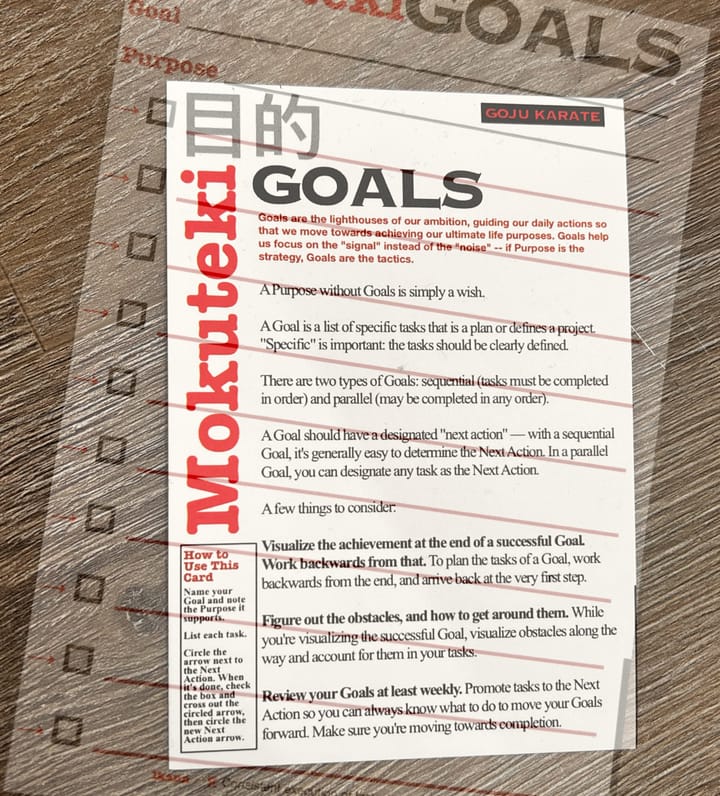
Our identity is the cornerstone upon which our purposes rest, and the foundation of our goals and aspirations. Having a complete and clear sense of our identity is a core part of being a karateka.
There exists in karatedō a profound concept that serves as the cornerstone of meaningful living: Jibunrashisa 自分らしさ [pronounced “jee-bun rah-sh-ee-sa”] . Translated literally as "self-like-ness" or "being like oneself," jibunrashisa 自分らしさ represents the essence of who we truly are beneath external layers of social expectations, outside pressures, and borrowed identities.
Jibunrashisa 自分らしさ is the sum total of our values; our beliefs; our perception of the world and ourselves, and our place in that world; and our hopes and dreams.
Jibunrashisa 自分らしさ is identity.
Jibunrashisa 自分らしさ is you.
A Complete Process
This concept offers a universal framework for understanding how genuine self-knowledge forms the foundation upon which meaningful purpose and achievable goals are built.
The journey from jibunrashisa 自分らしさ to ikigai 生き甲斐 (reason for being) to mokuteki 目的 (goals or projects) represents a natural progression: the end result is not only a complete understanding of who you are, but also why you exist and your fundamental life-purposes, and a plan for moving forward to fulfill those purposes.
It is a process that moves from the internal to the external, from understanding who we are to discovering why we exist, and finally to determining what we must do. This is a coherent philosophy for living meaningfully and purposefully.
Why is Identity So Important?
Identity is often compared to being a "shield" – a shield against all the conflicting forces in life and the vicissitudes of the day to day.
If we have a strong sense of identity, it is much harder for all the inputs in our day to push us off-course.
Identity is part anchor and part compass.
Identity anchors and stabilizes us when the inevitable happens: there are hundreds of influences that impinge upon us on any day, and without an identity to anchor us strong, it would be easy to become confused or unduly influenced, and move away from who we are.
Identity isn't a map, but it is definitely a compass: identity show us the direction that we should be moving towards, and keeps us pointed in the right direction in alignment with our purposes and goals. Identity doesn't show us every step of the way, or the destination (that's the point of having goals and purposes): however, the first step towards aligning with our purposes and following our goals is to know the direction in which to move. Identity does that for us.
Without identity, we are oftentimes cast adrift, to be buffeted by self-doubt and confusion, as well as many external forces that seek to influence us.
In this way, identity shields us from those influences, protects us from confusion, and supports us through self-doubt.
Identity Isn't Just Personal
Jibunrashisa 自分らしさ isn't solely a matter of personal identity: families have an identity, for instance. Organizations like a dojo or a company also have an identity.
Everything that a strong sense of identity does for a person, it does for any other entity. A strong sense of identity for a family, for instance, helps to create and support a strong sense of a family's culture, values, history, and more.
For larger entities like a dojo or a company, a strong jibunrashisa 自分らしさ helps to preserve the essential characteristics that define that entity. We often see what happens when companies forget their true identity and lose a sense of who they are: quality of product decreases, and customers move away from the company.
Remember, jibunrashisa 自分らしさ is who we are: to forget who we are means, fundamentally, that we are lost. This is true for a person, and is true for a company.
What does Identity Look Like?
It's very easy to get stuck in esoteric definitions of identity – that's always a danger with abstract ideas that are complex. So let's define exactly what jibunrashisa 自分らしさ might look like for someone:
I am a loving father and husband. My family is the most important thing in my life. I lead, protect, provide for, and educate my family. I am focused on being the best dad and husband now, and preparing my family for the future.
I am a proud son. I love and value my parents and am so grateful for them.
I am a good friend. I choose my friends carefully and focus on a small number of true friends to whom I can be the best possible friend.
I am very interested in my religion and in philosophy, and I am a seeker of knowledge and insight.
I practice karatedō and I am a karateka. The concepts in karatedō help me understand the world and myself and inspire me to become a better version of me. I am also focused on strong health, both physical and mental.
In addition to my karatedō I also engage in, and value deeply, a strong and healthy body which includes exercise as well as eating good foods that nurture my body and celebrate my spirit.
I am proud of my business helping companies be successful in communicating about their products and services and I strive to give my clients the most effective guidance possible.
I am a producer and maker of services and things that are meaningful. I want to create a legacy of impact in every part of my life.
My personality is always optimistic, calm and pleasant. I have discipline and focus in every part of my life, and I am determined to focus on what is important to me and discard the rest.
A well-crafted identity is very unique to you: certainly you'll have ideas that are common to the identity of others, but your jibunrashisa 自分らしさ is a very intimate reflection of who you are.
Common Themes in Jibunrashisa 自分らしさ
There are several specific things to consider in regards to identity.
- Unique: Identity is specific to you.
- Now: Identity describes who you are now, not who you want to become.
- Everything: Identity includes every part of your life, including your relationships, your professional or academic life, and your values and what you value.
- Clear: Your identity is clear and concise and is simply stated.
- Important: Your purpose in life, and your goals and projects, and all the tasks that you perform all flow out of your Identity.
- Shield: Your identity is your shield. It protects you from all the noise and distractions and wrong paths that would take you away from who you truly are.
Jibunrashisa 自分らしさ is Who You are Right Now
Your identity isn't a wishlist or a set of goals: Jibunrashisa 自分らしさ is a statement of who you are right now.
If identity is going to be an anchor for you, then it has to be a solid, static thing. It can't be "evolving" towards anything. Your identity has to be something that you can rely on. And your identity has to be stable so that it can drive your purposes and your goals.
When you work on your identity and start writing a statement of your identity, keep this point in mind: write in the present tense (e.g. "I am a good daughter" and not "I will be the best daughter"), and you may find it helpful to write in the first person (e.g. "I am a strong leader" rather than "Strong leadership is a value".)
Your Identity can Change
While it's true (and important) that your identity is a statement of who you are right now, that doesn't mean you can't change your identity.
You certainly are not the same person you were ten years ago, and therefore your identity must consequently be different.
How has your identity changed? Has it changed in response to external factors, such as changes in your job or events in your community? Or has it changed because of internal factors, such as through contemplation, study, and increasing maturity? All of these vectors of change are important and equally effective and legitimate.
Identity as Shield
Your identity is a very dynamic shield, able to adapt itself as the situation warrants.
This is important because your identity is going to guide all that you do. For example, if part of your identity is that you value your health and that the food and drink you have supports this value, then you aren't going to be making a side-trip from the grocery store to find a liquor store and buy a bottle of gin.
Moreover, if you are at a business function, and alcoholic drinks begin to be passed around, your identity guides you in passing them by, since the consumption of alcohol is diametrically opposed to your identity as someone who values health and consumes drink that supports this value.
Your day and your life will be filled with a cascade of influences that will threaten to move your sense of purpose and your goals away from what you wish. Your identity will act as a shield and counter-weight against those influences.
Just as in ancient times, a shield can also act as a weapon (Roman legions, for instance, carried a sword and shield as standard issue, and used both in an offensive ability as well as using a shield defensively). Your identity can act to cut through confusion and pare down all the noise that threatens to inundate you and distract from purposes and goals that aren't in alignment with your identity.
Many times, in fact, your identity can cut away the non-essential to allow you to focus on what is important and essential.
Writing an Identity Statement
Your identity is multifaceted and any statement of your identity has to also be similarly wide-ranging. It is very helpful to be clear and concise: simple and direct language will help you fix your identity in your consciousness.
Besides including the obvious statements about your relationships and the roles you play in them, your identity also consists of your values. It's worth noting that includes your abstract values ("discipline", "faithfulness", etc.) as well as the people and things that you value.
Your abstract values are a kind of lens through which you see yourself; the things and people you value are a lens through which you see the world around you, and your place in it.
In fact, the process of writing an identity statement for yourself is really an exercise in focusing the lens through which see all the different aspects of yourself and bringing that focus into sharp clarity.
Your identity is also a statement of the important ideas, people, and things in your life. An identity statement is rarely longer than a page or so of clear and well-distilled writing. That distillation of what is important and what is specific to you is what gives the idea of jibunrashisa 自分らしさ so powerful.
Understanding Jibunrashisa 自分らしさ as Very Personal Identity
Jibunrashisa 自分らしさ is not merely self-awareness or self-knowledge in the simplistic psychological sense. It encompasses a deeper understanding of one's real nature, including inherent qualities, natural tendencies, values, and the unique way one experiences and responds to the world. The concept suggests that each person has an intrinsic "selfness" that, when recognized and expressed, leads to a sense of wholeness and genuine satisfaction.
Aspects of our identity may often be discovered through actual experience rather than abstract introspection. An understanding of our identity can emerge from paying attention to moments when one feels most alive, most natural, most at ease with oneself. These moments serve as guideposts, revealing the contours of our true identity.
A person living with jibunrashisa 自分らしさ is said to be living in a way that is "like themselves," meaning their actions, choices, and expressions align with their true nature rather than conforming to what others expect or what society dictates.
It is important to note that if we do not actively work to write and understand a statement of our jibunrashisa 自分らしさ, then we cede the formation and maintenance of our identity to other people, other organizations, and other influences. This results in the most discordant situation in which our true identity is not in accord with our understood "identity."
This concept challenges the notion that identity is something we construct or choose entirely through conscious effort. Instead, jibunrashisa 自分らしさ suggests that identity has both discovered and cultivated aspects. We don't create ourselves from nothing; rather, we uncover who we already are and then nurture that true self to fuller expression. This understanding removes much of the anxiety associated with identity formation, replacing the pressure to "become someone" with the gentler invitation to "be oneself."
The process of discovering jibunrashisa 自分らしさ often involves recognizing patterns in our experiences. What activities make time disappear? In what environments do we feel most comfortable? What values do we refuse to compromise even under pressure? What brings us joy without external reward? The answers to these questions reveal the architecture of our true identity. They show us not who we think we should be, but who we actually are when all pretense falls away.
From Jibunrashisa 自分らしさ to Ikigai 生き甲斐: The Next Step
Once we have established a foundation of jibunrashisa 自分らしさ, we can begin to explore ikigai 生き甲斐, our reason for being. While jibunrashisa 自分らしさ answers the question "Who am I?", ikigai 生き甲斐 addresses "Why am I here?" or "What makes my life worth living?"
The relationship between these concepts is not coincidental; real purpose naturally flows from real identity.
Ikigai 生き甲斐 is often visualized as the intersection of four elements: what you love, what you are good at, what the world needs, and what you can be rewarded for. However, this popular interpretation, while useful, simplifies a more nuanced concept.
In its true context, ikigai 生き甲斐 represents the things that make one's life feel valuable and meaningful. It encompasses small daily joys as well as grand life purposes, from the pleasure of morning tea in a quiet house to the satisfaction of contributing to one's community.
The connection between jibunrashisa 自分らしさ and ikigai 生き甲斐 is crucial: when we understand our true identity, we can identify which purposes resonate at our deepest level. A purpose derived from our true self possesses a different quality than one adopted because it seems impressive or worthy.
Real purpose feels inevitable rather than forced, natural rather than constructed. It doesn't require constant motivation because it emerges from who we are rather than who we think we should be. In other words, true ikigai 生き甲斐 emerges from our identity.
For example, someone whose identity includes deep curiosity, patience, and joy in witnessing growth might naturally find purpose in teaching, mentoring, or nurturing. The purpose isn't imposed from outside but emerges organically from their true identity. They don't need to convince themselves that teaching matters; they feel its importance in their bones because it aligns with their fundamental way of being. It aligns with their jibunrashisa 自分らしさ .
This alignment between identity and purpose creates sustainability. When our purpose derives from our real self, we're drawing from a renewable resource rather than depleting our willpower. We're not constantly swimming against our nature but moving with its current. This doesn't mean the path is always easy, but it means the difficulty feels worthwhile rather than exhausting.
Moreover, ikigai 生き甲斐 rooted in identity tends to be multifaceted rather than singular.
Just as our identity comprises many qualities and tendencies, our purpose often manifests in various domains of life. We might find purpose in relationships, creative expression, service to others, personal growth, and connection to nature simultaneously. These different expressions of purpose, when rooted in real identity, reinforce rather than conflict with each other because they all flow from the same source.
From Ikigai 生き甲斐 to Mokuteki 目的: Translating Meaning into Action
While ikigai 生き甲斐 provides the "why" of our existence, mokuteki 目的 represents the "what" and "how." Mokuteki 目的 are goals, aims, or objectives—the concrete manifestations of our purpose in actionable form. If jibunrashisa 自分らしさ is the foundation and ikigai 生き甲斐 is the architecture, mokuteki 目的 represents the actual structure we build upon that foundation and according to that design.
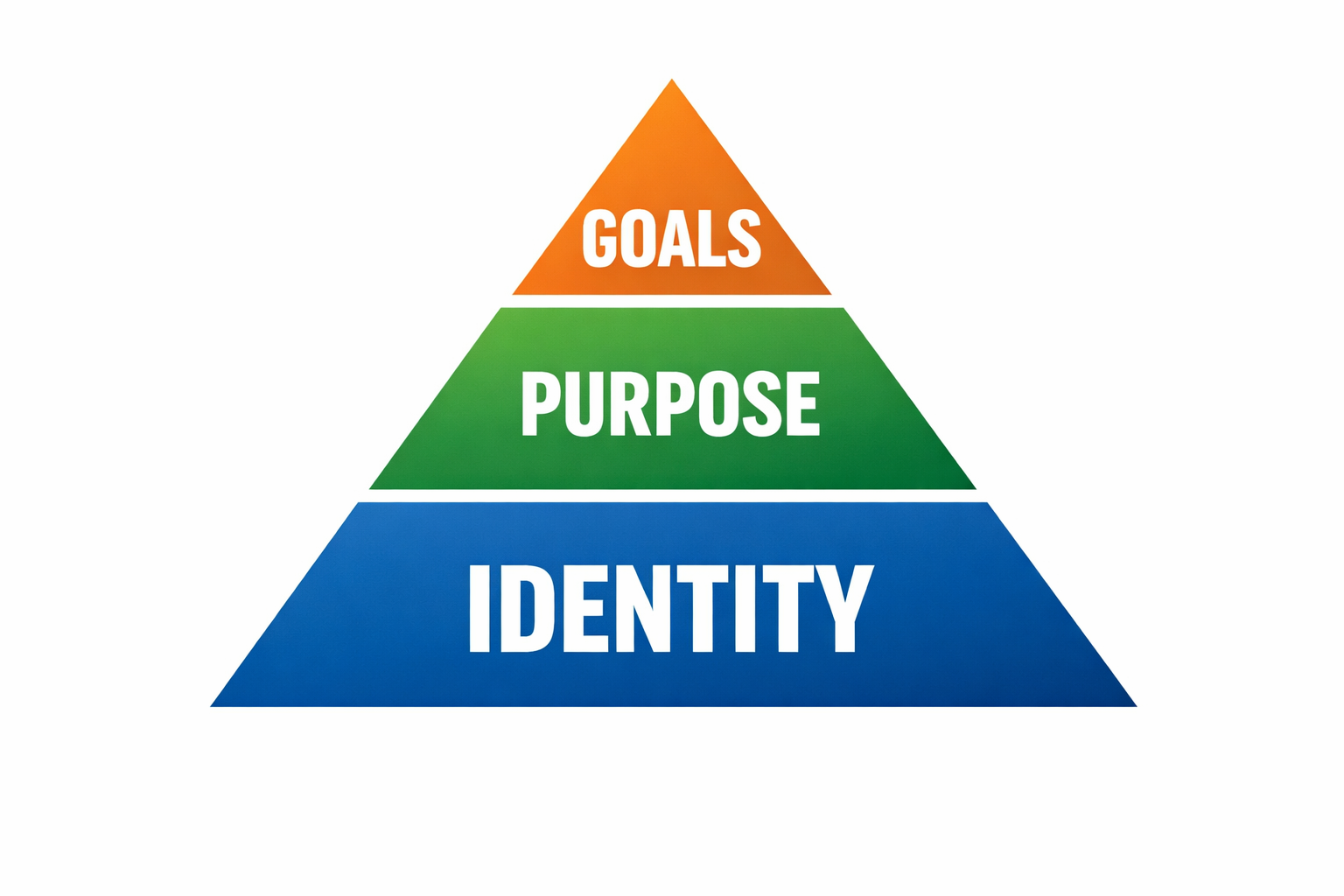
The derivation of goals from purpose is where many people stumble, often because they attempt to set goals without first establishing the underlying layers of identity and purpose. Goals detached from real purpose become mere achievements—they may be accomplished, but they don't necessarily bring fulfillment. Goals derived from purposes that don't align with one's true identity lead to even greater dissonance, creating a life of accomplishment without satisfaction.
Life, unfortunately, is replete with so many examples of this dissonance. The medical student that works so hard to become a physician, and discovers two decades later that being a physician isn't a part of their real identity. Or the man who labors for decades to accumulate vast wealth, and then discovers there is no actual purpose in doing so.
Empty goals that come from random purposes which derived from an identity force-fitted and influenced by others leads to ultimate unhappiness
When mokuteki 目的 flows naturally from ikigai 生き甲斐, which in turn flows from jibunrashisa 自分らしさ, goals take on a different character. They become expressions of who we are and why we exist rather than arbitrary markers of success. This hierarchical relationship creates coherence in our lives, where daily actions, long-term objectives, and fundamental identity all point in the same direction.
Consider how this process might unfold: A person discovers through self-reflection that their identity includes traits like deep listening, vast curiosity, and joy in taking complex ideas and making them understandable. From this real identity, they might derive a purpose centered on helping others understand events and history. This purpose then naturally generates goals such as becoming a writer, developing skills in historical analysis, creating communities to study and understand current events. Each goal serves the purpose, which expresses the identity.
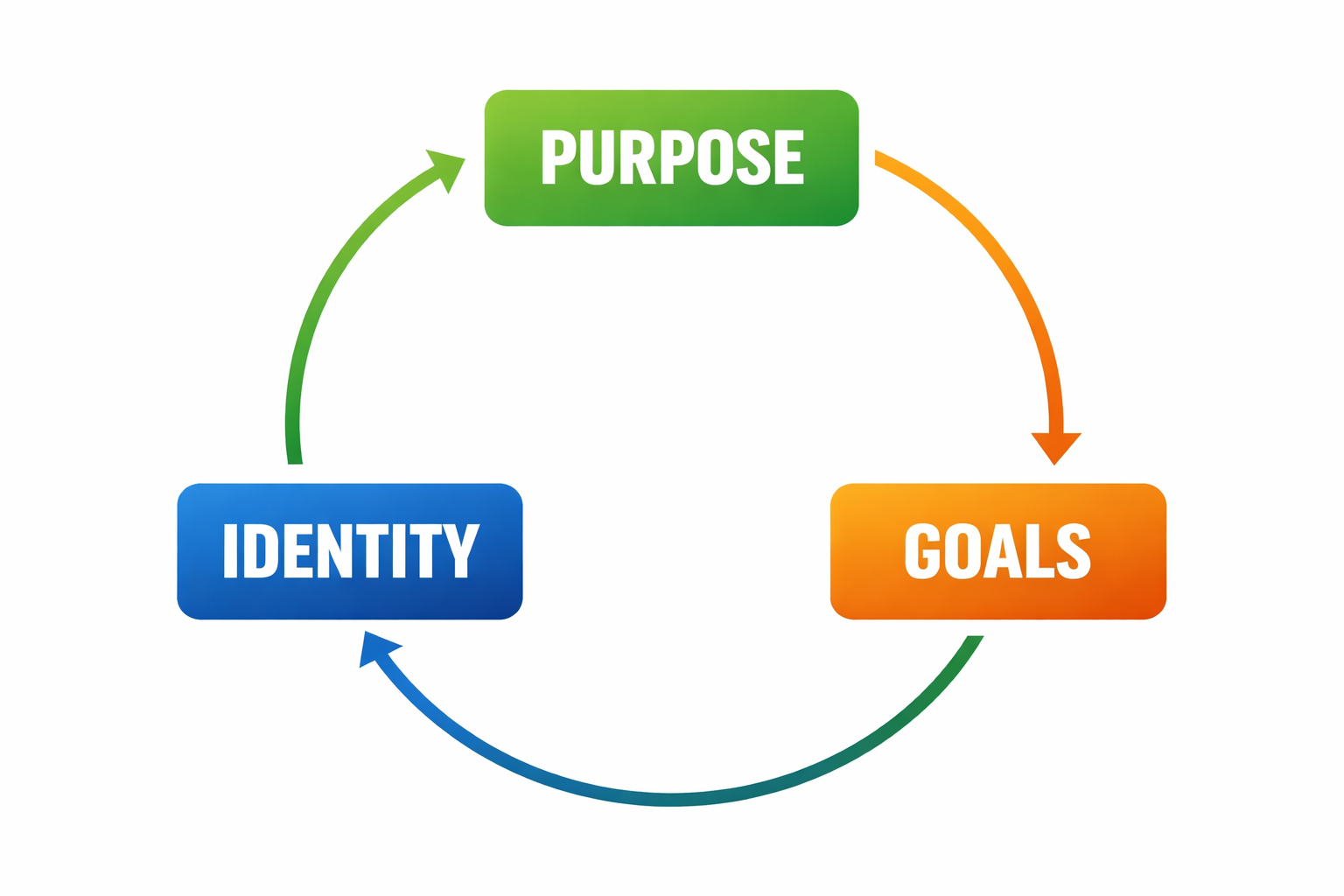
The beauty of this progression is its self-reinforcing nature. Pursuing goals that align with our purpose strengthens our sense of purpose. Living with purpose that aligns with our identity reinforces our understanding of who we are. Each level supports and validates the others, creating a stable foundation for a meaningful life.
The Integration: A Coherent Philosophy of Self
The progression from identity to purpose to goals represents more than a linear process; it creates a dynamic system where each element continuously informs and refines the others. As we pursue our goals, we learn more about our true identity. As our understanding of ourselves deepens, our sense of purpose becomes more nuanced. As our purpose evolves, our goals shift to better serve that purpose.
This system also provides diagnostic power. When we feel stuck, unfulfilled, or exhausted despite achievement, we can trace the problem back through the layers. Goals that feel burdensome might reveal a misalignment with purpose. A purpose that feels hollow might indicate disconnection from true identity. By regularly returning to jibunrashisa 自分らしさ as our foundation, we ensure that our entire life structure remains aligned with who we truly are.
The karatedō concepts embedded in this framework offer wisdom often missing from superficial achievement culture.
Rather than starting with external markers of success and working backward, this approach begins with the self and works outward. Rather than asking "What should I accomplish?" it asks "Who am I?" first. This inversion creates fundamentally different lives — lives characterized by true satisfaction rather than performance that is more "performance art" than achievement and that demonstrate meaning rather than mere cosmetic markers of success.
Furthermore, this framework recognizes the truth that we are not static beings. Our identity has certain enduring qualities, but our understanding of it deepens over time. Our purpose might shift as we move through different life stages. Our goals will certainly change as some goals are achieved and new ones emerge.
This entire system is flexible enough to accommodate growth while stable enough to provide direction.
The Path to Living a Life of Substance
The journey from jibunrashisa 自分らしさ to ikigai 生き甲斐 to mokuteki 目的 offers a profound alternative to the scattered, externally-driven approach to life that characterizes much of modern purpose-less existence. By beginning with true self-knowledge about our identity, deriving purpose from that identity, and setting goals that serve that purpose, we create lives of remarkable coherence and meaning.
This is not a quick process. Discovering jibunrashisa 自分らしさ requires honest self-reflection and the courage to acknowledge who we really are rather than who we wish we were.
Identifying real ikigai 生き甲斐 demands patience as we distinguish between purposes that truly resonate and those we've adopted from others.
Setting meaningful mokuteki 目的 requires discipline to choose goals that serve our purpose rather than simply look impressive.
Yet the rewards of this approach are immeasurable. A life built on this foundation possesses an integrity that no amount of achievement can provide on its own. It offers the deep satisfaction of knowing that our daily actions express our fundamental nature and serve our most cherished purposes. It creates resilience because we're not dependent on external validation—we know we're living in accordance with our identity.
In a world that constantly tells us who to be, what to want, and what to achieve, the wisdom embedded in jibunrashisa 自分らしさ, ikigai 生き甲斐, and mokuteki 目的 offers a different path. It invites us to begin with ourselves, to trust our true nature, and to build lives that reflect who we truly are and have real purpose and substance.
This is not merely the path to success, but to genuine fulfillment — lives of substance that make a lasting impact and create a legacy of real achievement.
| Kanji/Katakana | Meaning |
|---|---|
| 自 | self (ji) |
| 分 | part (bun) jibun is oneself |
| らし | typical of (rashii) |
| さ | noun form (sa) |
Editor's Note Regarding Jibunrashisa 自分らしさ versus Jibunrashii 自分らしい
Sometimes the concept of "identity" is written as jibunrashii 自分らしい. However, this is incorrect.
The difference between jibunrashisa 自分らしさ and jibunrashii 自分らしい is primarily a matter of grammar, which shifts the focus from an "idea" to a "description."
- Grammatical Difference
Jibunrashisa (Noun): The suffix -sa turns an adjective into a noun (similar to adding "-ness" in English). It refers to the concept or quality of being yourself.
Translation: "Identity," "uniqueness," or "authenticity."
Jibunrashii (Adjective): This is the descriptive form. it describes an action, state, or object that matches who you are.
Translation: "Typical of me/you," "becoming of oneself," or "true to oneself." - Difference in Nuance
Jibunrashisa focuses on your internal core. It’s the abstract identity you possess. You "search for" or "lose" your jibunrashisa.
Jibunrashii focuses on outward behavior. It describes things that fit your style or personality. If you do something your friends expect of you, they might say, "That’s so jibunrashii (typical of you)."
Editor's Note: This lecture was first delivered by Sensei in New York City on January 10, 2026 as the official Kagami Biraki lecture of that year. (Read more about Kagami Biraki here.)