Kanku Dai is present in every major school of karatedō and many other martial arts lineages. The history of the kata is almost as fascinating as the kata itself.
The kata Kanku Dai 観空大 is, by any measure, one of the great kata of karatedō.
In some schools of karatedō, it is the longest, most complex kata. While it isn’t the longest kata in our dojo’s syllabus, it is among the longer ones. It is the kata that Gichin Funakoshi chose to perform when he introduced karate to Japan. It is the quarry from which some parts of the Pinan family were cut (since both Kanku Dai and the original Pinan kata were contemporaries). And — under its older name, Kusanku — it is one of the very few kata whose story can be tied to a dated, written record of the eighteenth century.
It is also a kata whose history comes wrapped in more legend than almost any other, and part of our work is to separate what was recorded from what has merely been repeated.
Unlike most kata of Chinese origin, Kanku Dai was not carried to Okinawa as a finished form. It was composed in Okinawa, by Okinawans, from what a Chinese visitor had taught them, and it was named in his honor. The name Kanku is barely ninety years old. For the first century and a half of its life the kata was called Kusanku, and in some Okinawan schools it still is.
Kusanku, the Man
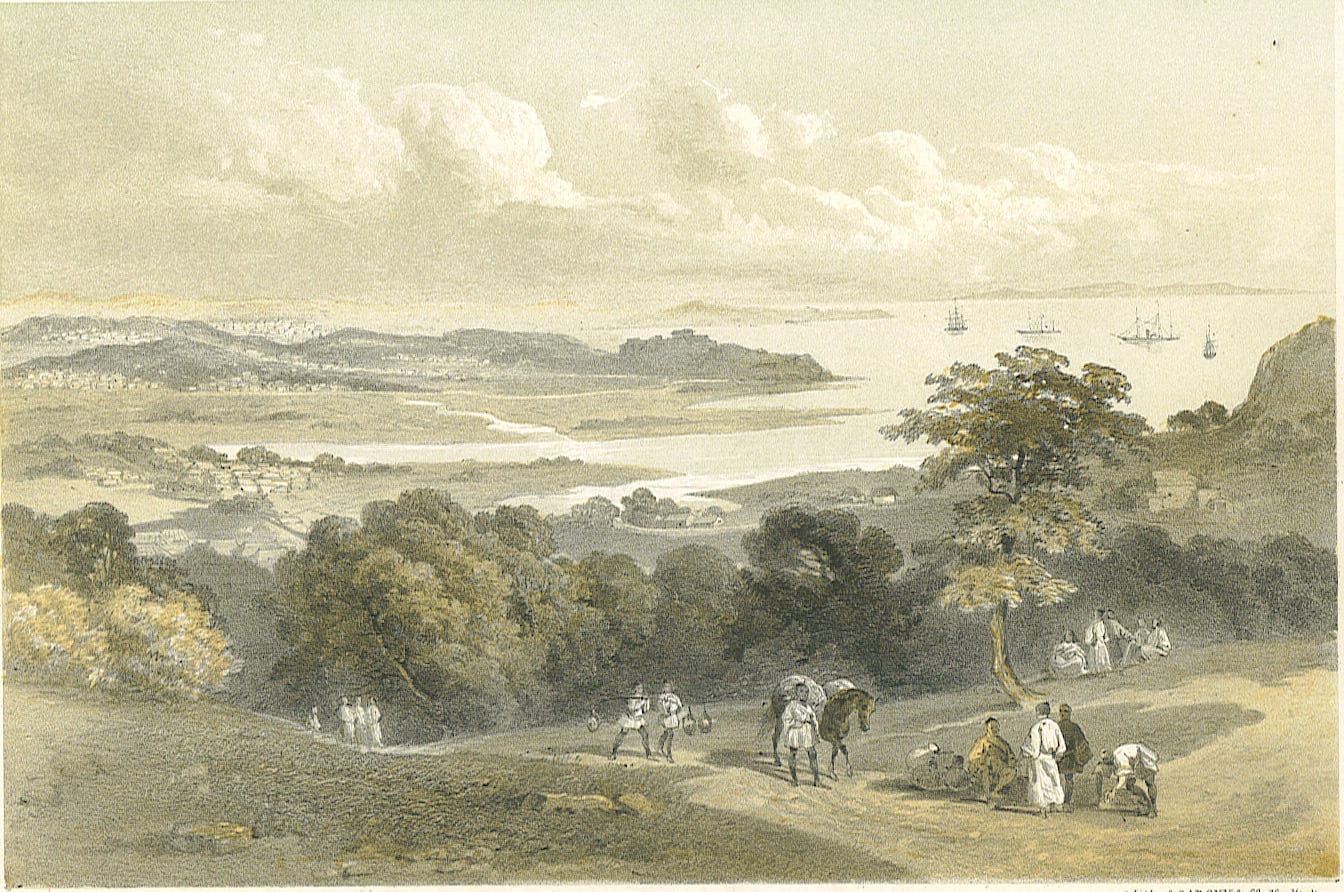
In the summer of 1762, a Ryukyuan tribute ship bound for Satsuma was caught in a typhoon, lost its mainmast and its rudder, and drifted ashore in Tosa Province, on the island of Shikoku. The crew was lodged at Ōshima for about a month while the ship was repaired, and a local Confucian scholar, Yoshihiro Tobe, took the opportunity to question the senior Ryukyuan aboard — an official named Shiohira Pechin — about everything he could think of: the government of the Ryukyu Kingdom, its poetry, its relations with China. Tobe’s notes survive as the Ōshima Hikki (“The Ōshima Notes”).
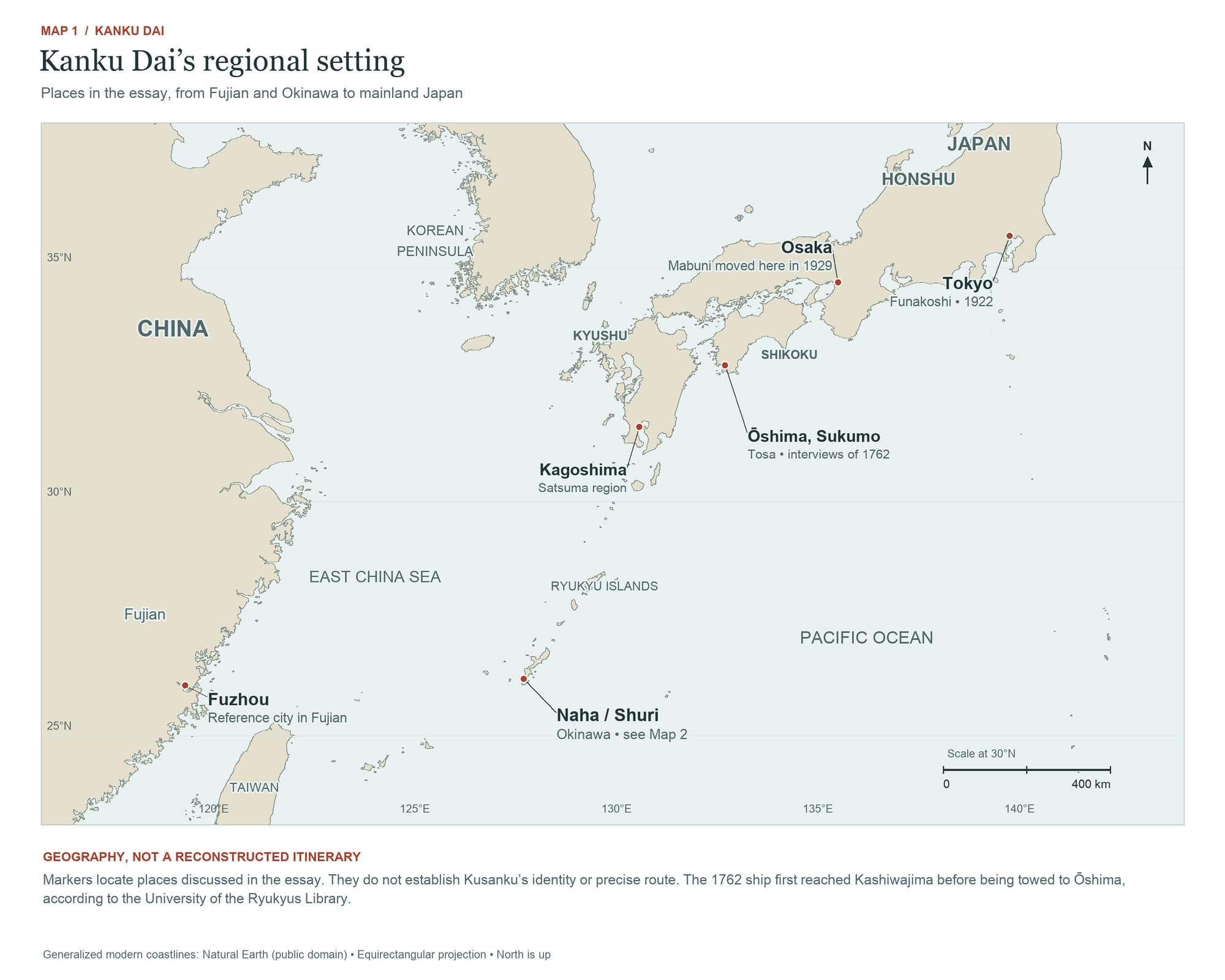
Among those notes is a short passage on the martial arts. Some years earlier, Shiohira said, a Chinese by the name of 公相君 had come to Ryukyu, bringing a number of his students with him, and had demonstrated an art that Shiohira called kumiai-jutsu — a grappling, or “engagement,” method. What impressed Shiohira was that a slight man could so easily defeat a larger and stronger one: he describes the expert with one hand placed at the lapel and the other hand at work, scissoring with his legs, and putting a powerful attacker on the ground.
That is all. The passage runs to a few lines, and it is the only contemporary record we have. But it is a remarkable few lines, because it is the earliest reliable written evidence of a Chinese fighting art being demonstrated in Okinawa, and because the three characters that Tobe wrote down are the same three characters with which the kata Kusanku is written to this day.
Who was he? Here we have to be careful. “Kusanku” is simply the Okinawan reading of 公相君; in Japanese the same characters are read Kōshōkun or Kōsōkun, and in Chinese Gōng Xiāng Jūn. And the characters themselves — kō 公 (public; a lord), shō 相 (a minister of state) and kun 君 (lord; an honorific) — read far more naturally as a title than as a personal name: something like “His Excellency the Minister.” The situation is much like that of Ryu Ryu Ko, the teacher under whom Kanryo Higaonna studied in Fuzhou, whose “name” is likewise thought to be a nickname or a form of address rather than the name his family gave him. In both cases we are almost certainly dealing with a form of address that the Okinawans remembered, and not with the man’s actual name.
Tradition dates his arrival to 1756. That date is significant, because 1756 is the year in which the Qing court sent an investiture mission to Ryukyu to confirm King Shō Boku on his throne — a mission led by the envoy Quan Kui and his deputy Zhou Huang, accompanied, as such missions always were, by an entourage of several hundred soldiers, officials, and experts of every kind.
Some researchers have concluded that Kusanku was Quan Kui himself. Others think it far more likely that he was a military officer in the envoy’s retinue, on the sensible ground that an imperial ambassador does not ordinarily give wrestling demonstrations. The accounts that remember him as a military attaché agree with the second view. We do not know for sure, but it's quite likely that he was, in fact, a senior member of the ambassador's retinue.
Sakugawa and Yara
According to tradition, Kusanku had two Okinawan students of consequence.
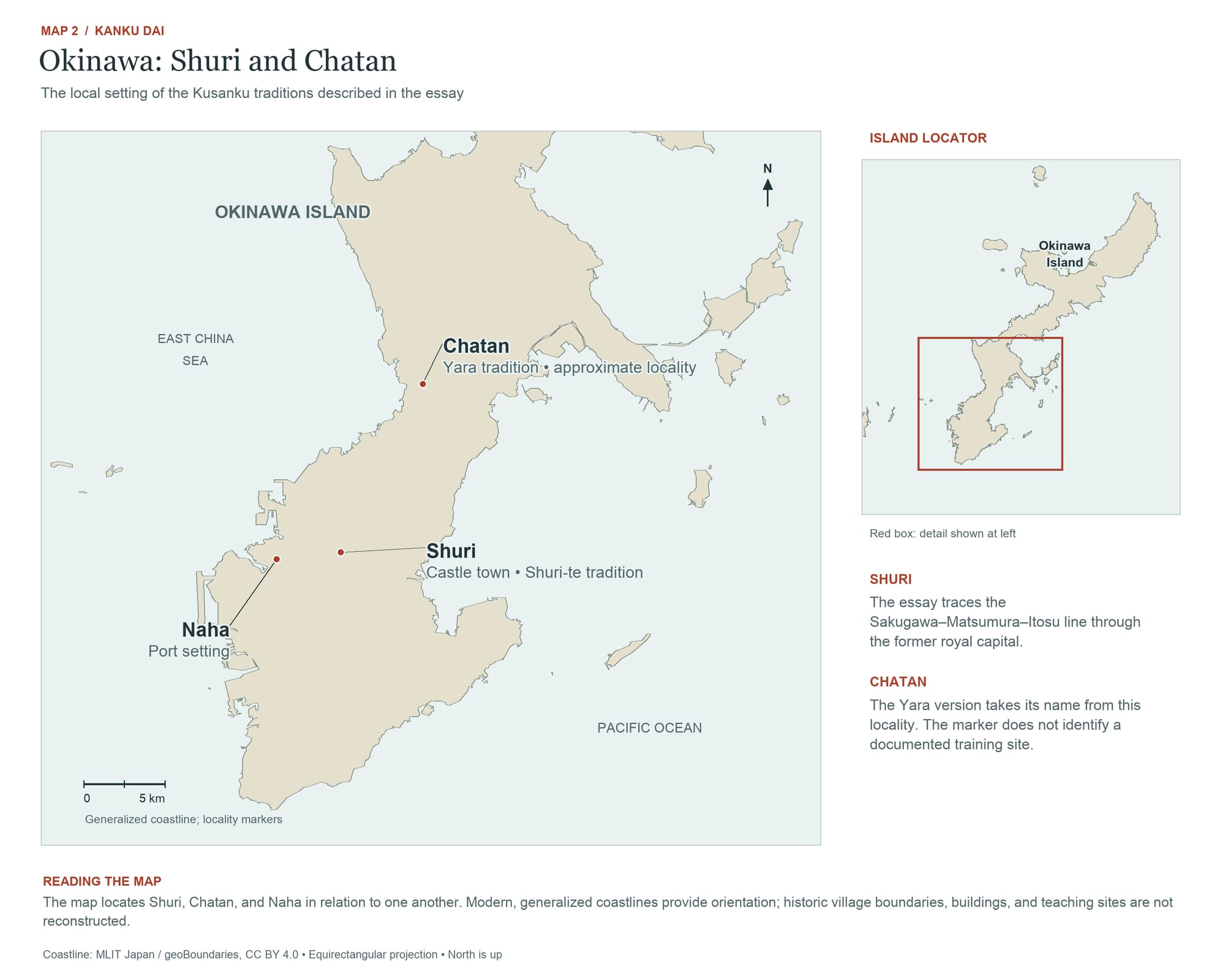
The first was Kanga Sakugawa, later famous as “Tōde” Sakugawa — “Chinese Hand” Sakugawa, a nickname given in recognition of his skill, and the same term that would, a century and a half later, be re-written and re-pronounced as karate. Sakugawa was at that time a student of Takahara Pechin. “Pechin” is a title rather than a name — it denotes a scholar-official of the Ryukyu Kingdom — and Takahara was a noted scholar, astronomer, and map maker, as well as Sakugawa’s first teacher. It is said that it was Takahara himself who urged his student to seek out Kusanku, believing him to be the most skilled martial artist ever to have come to Okinawa. Sakugawa, by the traditional dating, was twenty-three years old. He trained under Kusanku for six years — in Okinawa, by some accounts; by others, he followed his teacher back to Fujian and returned home only in 1762 — and when Kusanku died, Sakugawa, then twenty-eight, composed a kata to honor his teacher and, more importantly, to record what he had been taught.
The second was Yara of Chatan village, known to history as Chatan Yara. His line produced a different version of the kata, Chatan Yara no Kusanku, which is longer than Sakugawa’s and generally thought to be closer in flavor to the Chinese original.
It was kept in the Yara family in Chatan for generations, and in the late nineteenth century it was taught to Chotoku Kyan, through whom it passed into several of the modern Shorin Ryu schools.
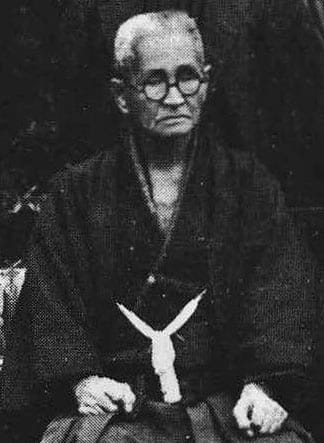
It must be said that the chronology of all this is far from secure. The dates of both Sakugawa and Yara are disputed by as much as half a century — Sakugawa is placed by some at 1733–1815 and by others at 1786–1867, and Yara anywhere from the late seventeenth century to the early nineteenth — and no document of any kind connects the kata to the man: the evidence is the name, and the oral tradition, and nothing more. What we can say with confidence is that by the early nineteenth century a kata called Kusanku was firmly established in and around the castle town of Shuri, that it existed in at least two distinct lines of transmission, and that both lines attributed it to the same Chinese visitor.
This illustrates, better than any other example we know, the importance of kata. Kusanku left no book, no scroll, and no school. There is no written text that archives the fighting method of a man who had an enormous influence on the development of karatedō. His students did the only thing that could be done: they bound what they had learned into a form, and handed the form down. It is worth noticing that what the kata preserves — seizing and turning the adversary, breaking his balance, dropping beneath his attack, and kicking as he recovers — is entirely consistent with the little that Shiohira described to Tobe in 1762.
Matsumura, Itosu, and the Dai and Sho
Sakugawa’s Kusanku descended to Sokon Matsumura — “Bushi” Matsumura, chief bodyguard to the last three kings of Ryukyu and the central figure of Shuri-te — and from Matsumura to his two great students, Anko Asato and Anko Itosu.
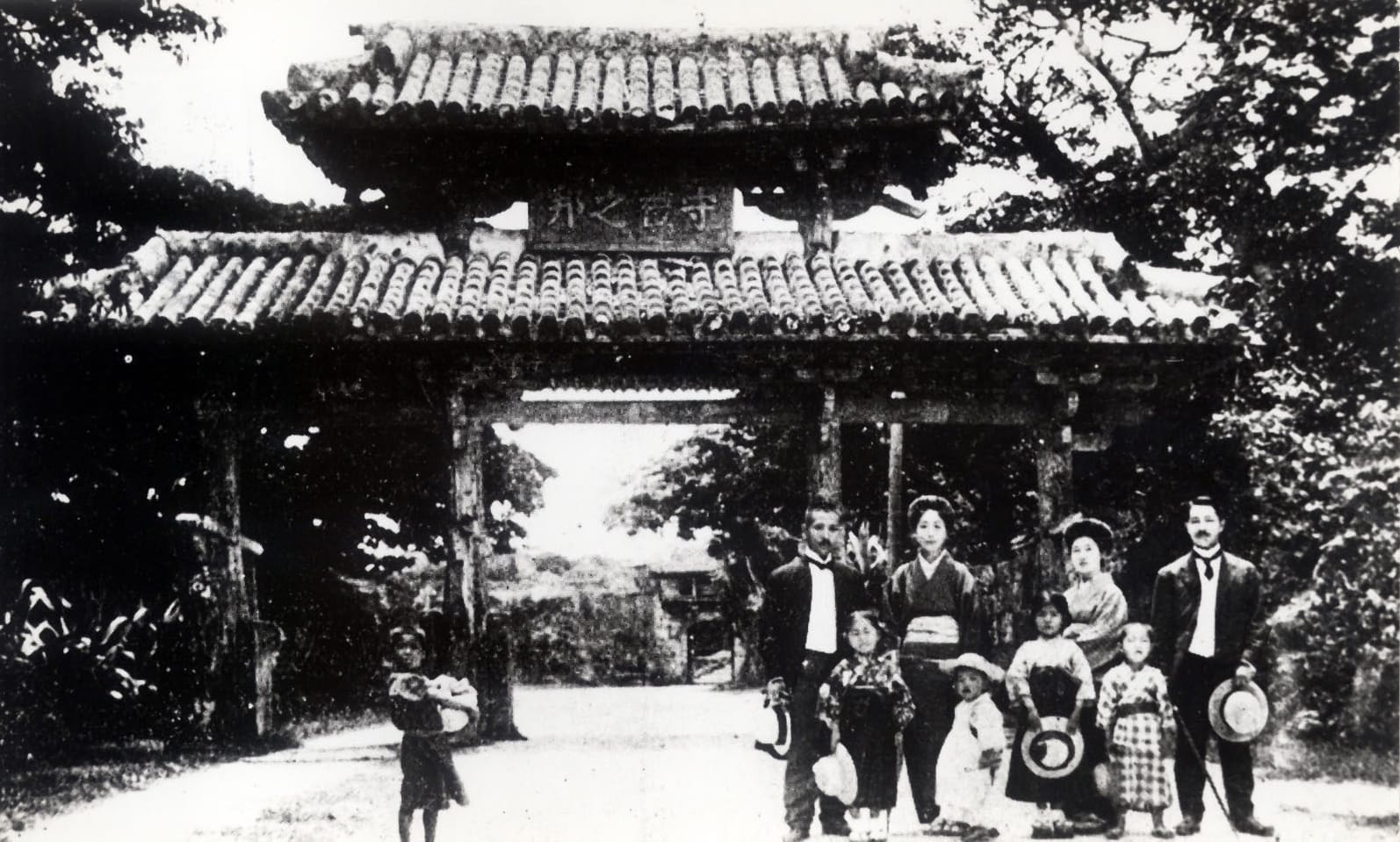
It was Itosu who gave the kata the shape in which most of the world now knows it.
In the first years of the twentieth century Itosu brought karate out of the private courtyard and into the public schools of Okinawa (the Shuri elementary school in 1901; the Prefectural Middle School and the Teachers’ College in 1905), and to do so he reorganized the old kata into forms that could be taught to large classes. From the single Kusanku that he had received from Matsumura he produced two: Kusanku Dai, the “greater,” which is the direct ancestor of the kata presented here, and Kusanku Sho, the “lesser,” a shorter and in some respects more difficult companion. (A third, Shiho Kusanku, “Four-Direction Kusanku,” is credited sometimes to Itosu and sometimes to his student Kenwa Mabuni.)
Itosu did one more thing with Kusanku, and it has touched every karateka since.
When, in 1904 and 1905, he and a group of other influential karatedō teachers created the five Pinan kata — the attempt to recreate a lost kata that was believed to have been extant around the same time as Kusanku —Kusanku Dai was his principal source for the contributions that he made to that effort. Anyone who has learned thePinan (sometimes referred to as Heian) family will recognize them, one after another, as Kanku Dai unfolds — most conspicuously in Pinan Four, but in all five. In a very real sense, the student who learns Kanku Dai is meeting the parent after having spent years with the children.
Also, around 1905, a very young Chojun Miyagi (he would have been 17 years old) was likely introduced to Kusanku — and in fact to Kusanku Dai and Kusanku Sho, with the possibility that he was also introduced to Shiho Kusanku, because Miyagi had a deep and long-lasting friendship and professional partnership with Kenwa Mabuni.
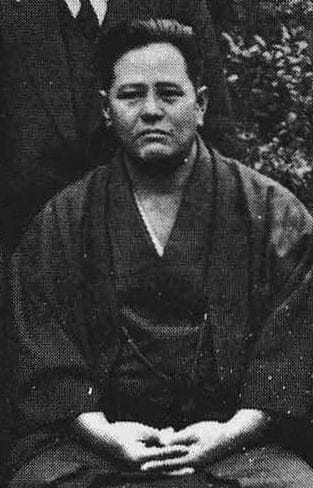
There is no direct evidence that Miyagi’s sensei at the time, Kanryo Higaonna, taught any form of Kusanku, although certainly he was familiar with it, and likely he taught some parts of it even before Itosu formalized it.
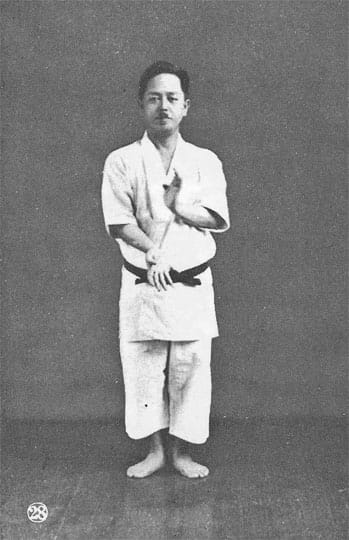
By 1908 or possibly early 1909, Miyagi and Mabuni were close friends and trained together (Mabuni even trained with Miyagi and Higaonna in the evenings, after having trained with Itosu earlier in the day). From that time, and through 1929 (when Mabuni moved to Osaka, helped by Jigoro Kano), Miyagi would have become quite adept at the various forms of Kusanku.
Funakoshi and the New Name
Gichin Funakoshi, the founder of Shotokan, was a student of both Asato and Itosu, and Kusanku Dai was, by every account, his favorite kata.
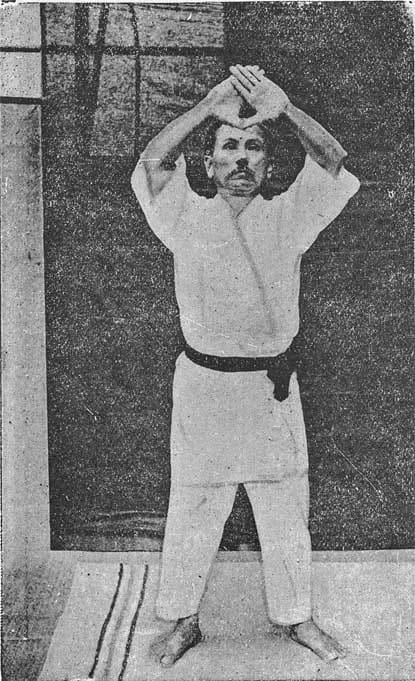
When Funakoshi traveled to Tokyo in the spring of 1922 to demonstrate karate at the first National Athletic Exhibition, Jigoro Kano, the founder of judo, invited him to give a further demonstration at the Kodokan. Before a hall filled to capacity, his young partner Shinkin Gima performed Naihanchi, and Funakoshi performed Kusanku.
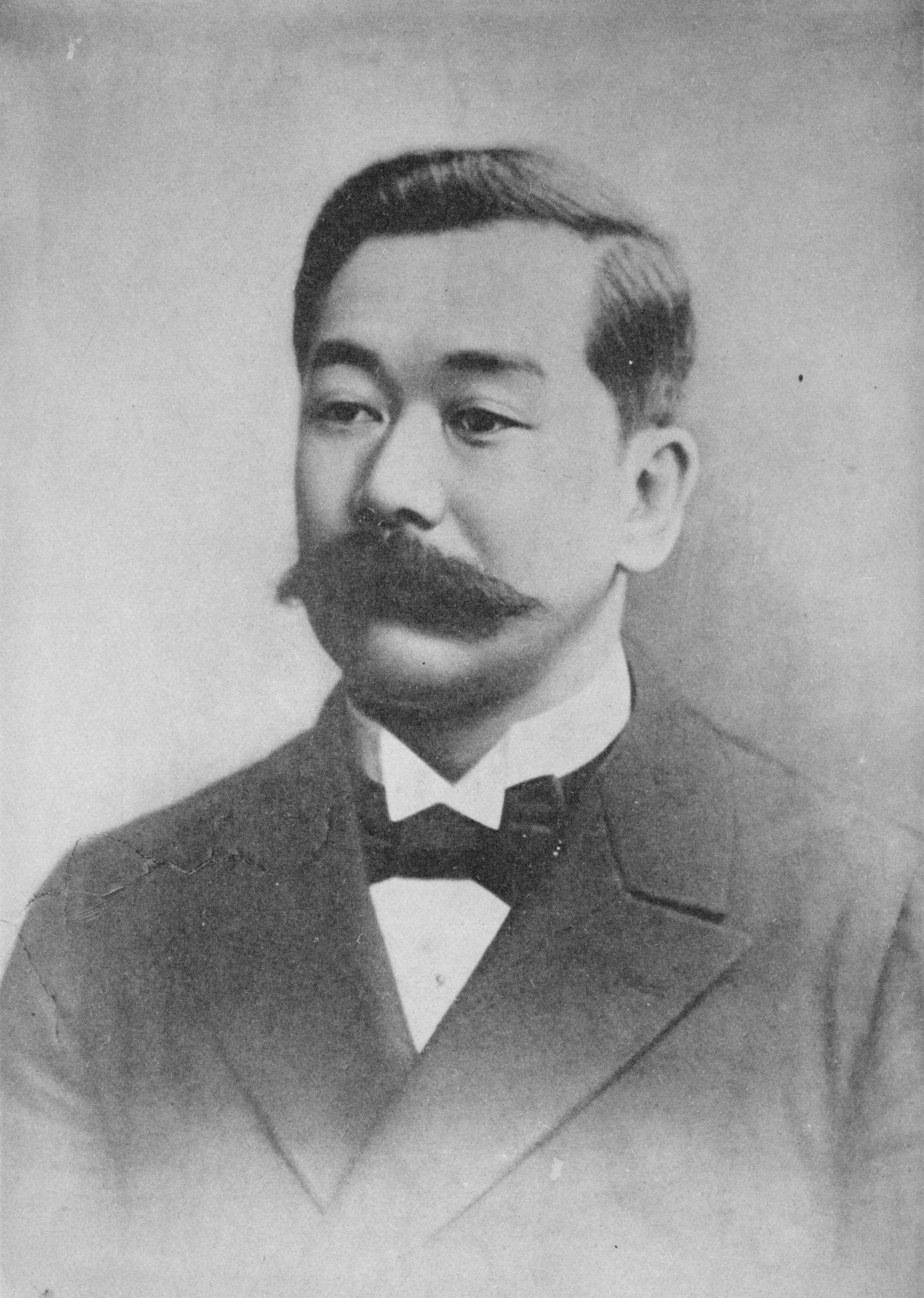
It was the success of that afternoon, more than anything else, that persuaded Funakoshi to remain in Japan. In his first book, Ryūkyū Kenpō Karate, published later the same year, the kata is still listed under its old name, Kūshankū 公相君.
The new name appeared in 1935, in Karate-dō Kyōhan. By then Funakoshi was re-naming nearly all of the kata he taught, replacing their Okinawan and Chinese names with Japanese ones: Pinan became Heian, Naihanchi became Tekki, Passai became Bassai, Wansu became Empi, Chinto became Gankaku. There was a practical reason for this. In the Japan of the 1930s, anything that sounded Chinese was a liability, and these were the same years in which the very name of the art was re-written, from 唐手 (“Chinese hand”) to 空手 (“empty hand”).
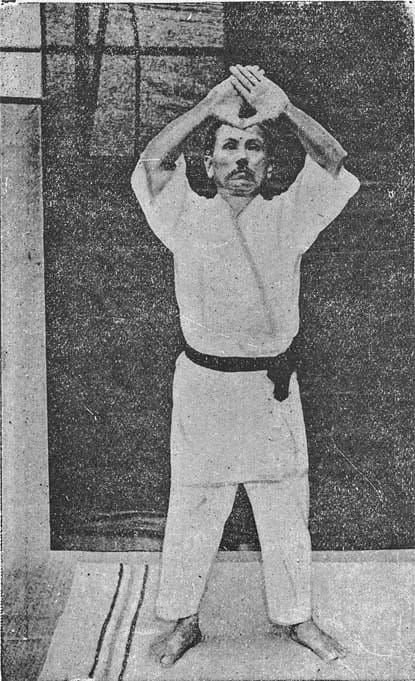
Kanku 観空 is therefore not an abbreviation of Kusanku, nor a translation of it — although the similarity of the two sounds is surely no accident. Kan 観 means “to view,” or “to contemplate”; kū 空 means “sky.” The name is taken from the unmistakable opening of the kata, in which the hands are joined, raised slowly overhead, and the karateka looks up through the opening between them at the sky. Dai 大, “great,” distinguishes the kata from its companion, Kanku Sho.
It is worth noting that the character 空 is the same character that Funakoshi placed, in the same years, at the front of the word karate, and that in Buddhist usage it means not only “sky” but “emptiness.” Funakoshi was by then a student of Zen, and was much occupied with the teaching that form is emptiness and emptiness is form. Kanku can thus also be read as “to contemplate emptiness.” Funakoshi’s own explanation was the simpler one; but the second reading is there for those who want it.
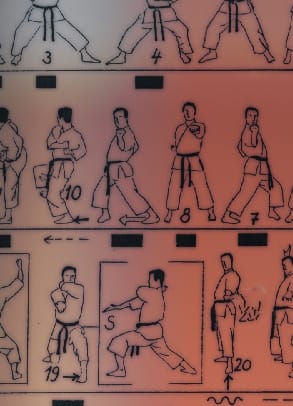
As Kanku Dai, the kata became the centerpiece of the Shotokan syllabus: sixty-five counts, performed in roughly ninety seconds, and for many years one of the compulsory kata of both the Japan Karate Association and international competition.
Likewise, within traditional forms of Goju Ryu, the kata (where eventually the kata also generally came to be called Kanku as well, as karatedō modernized and outgrew Okinawa) the kata is considered a very senior kata, usually a dan-level kata.
The Kata in Other Schools
Because it descends from Itosu, from Kyan, or from both, some form of Kusanku is found in nearly every school of karatedō in addition to Goju Ryu and Shotokan:
Kyokushin. Mas Oyama trained in Shotokan under the Funakoshis (both Gichin and Gigo) for about a year and a half starting in 1938, then trained extensively with So Nei Chu (sometimes referred to as Nei-Chu So), an uchi-deshi of Chojun Miyagi, and carried Kanku, along with many Goju Ryu kata, with him into Kyokushin, where it is one of the senior kata.
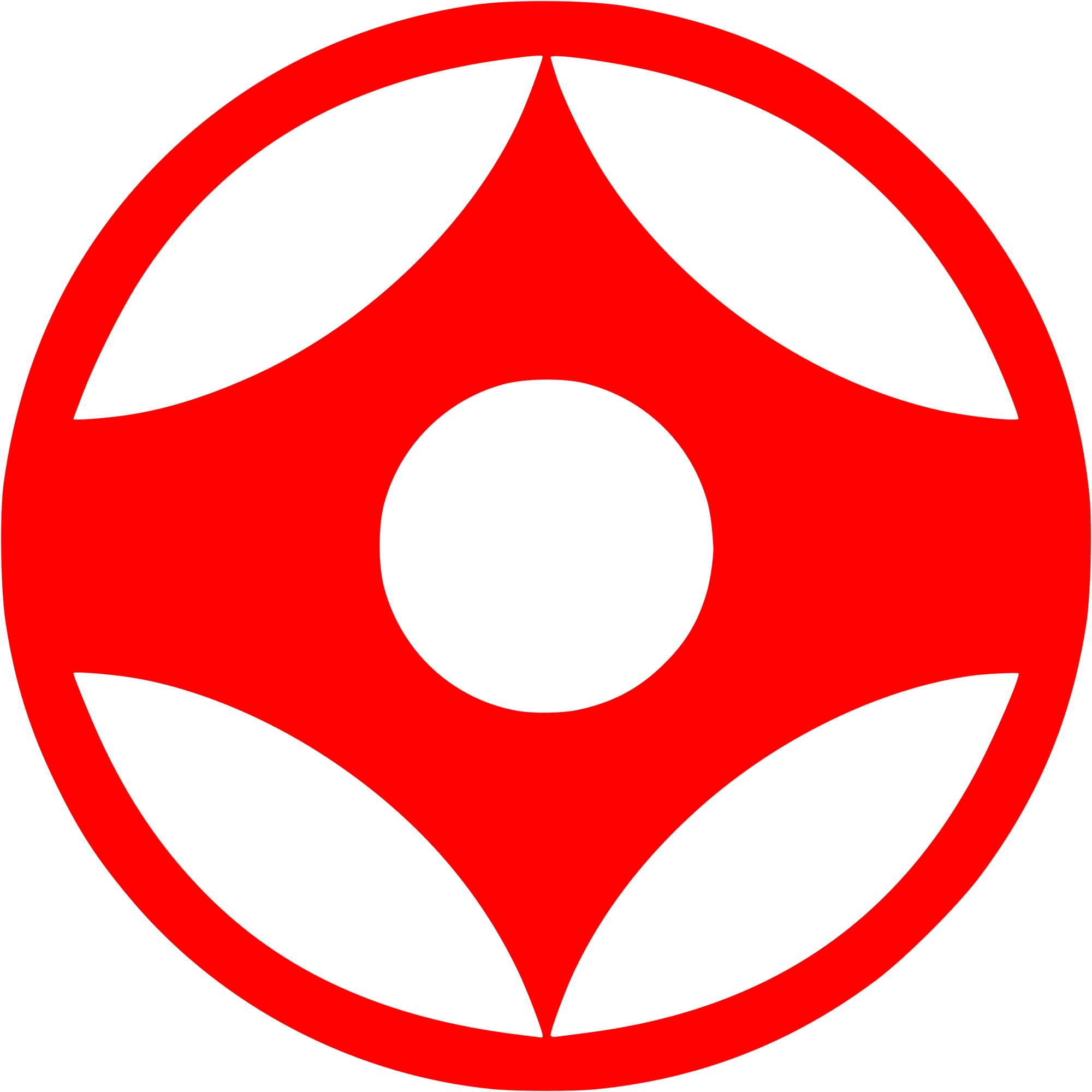
It also gave Kyokushin its emblem: the kanku, the symbol worn on the chest of every Kyokushin dogi, is a stylized drawing of the opening movement of this kata — the points at the top and bottom are the fingertips, the thick sections at the sides are the wrists, the open center is the sky seen between the hands, and the whole is enclosed in a circle.
Shito-Ryu. Kenwa Mabuni, a student of Itosu, kept the original characters 公相君 but gave them their Japanese reading; the school therefore practices Kōsōkun Dai, Kōsōkun Sho and Shihō Kōsōkun, and some branches have added Chatan Yara no Kusanku as well.
Wado-Ryu. Hironori Otsuka, who learned the kata from Funakoshi and refined it with Mabuni, retained the older name, Kūshankū.
Shorin Ryu. The Kobayashi school of Choshin Chibana, Itosu’s senior student, practices Kusanku Dai and Kusanku Sho in Itosu’s form. The schools that descend from Chotoku Kyan — Matsubayashi Ryu, Shorinji Ryu, Seibukan — practice the Yara version.
Isshin Ryu. Tatsuo Shimabuku learned Kusanku from Kyan, and later built a sai kata, Kusanku Sai, on its framework.
Korean styles. In Tang Soo Do and Soo Bahk Do the kata is called Kong Sang Koon — once again, simply the local reading of 公相君 — having been learned by the Korean founders of those styles in the Shotokan dojo of the 1930s and 1940s.
Legend and Symbolism
Over the years, a great deal of symbolism has been attached to this kata, and as there are no early written records of it, the symbolism is impossible to confirm and difficult to dismiss.
The opening circle of the hands is variously said to represent the sun, the moon, the universe, or the union of in and yō(yin and yang); and the great arc of the arm at the very end of the kata is commonly explained in the same way, or as the flight of the moon across the sky. An old and persistent story holds that Kusanku is a “night-fighting” kata — that its sudden drops to the ground, its searching hands, and its glance upward were meant to place an unseen adversary against the skyline.
Where these readings come from is uncertain. Many of the metaphysical explanations in circulation today can be traced to the Isshin Ryu line, whose founder, Tatsuo Shimabuku, had a deep and lifelong interest in Taoist thought and Chinese divination. It is also sometimes pointed out that the kata’s reputed composer, Sakugawa, was trained by an astronomer, and may have enjoyed setting the fighting method of a military man like Kusanku within the celestial imagery he had learned from Takahara. It is a pleasing idea. But it rests on nothing earlier than the twentieth century, and it should be held lightly.
One Final Look Up to the Heavens
What can be said is this: a Chinese expert, remembered only by his title, came to Okinawa in the middle of the eighteenth century and made a deep impression on those who saw him. Okinawan students of his method bound what they had learned into a kata and gave it this man’s name. That kata became one of the pillars of every single major school of karatedō; it was re-shaped by Itosu, carried to Japan and re-named by Funakoshi, taught by Miyagi to his most senior and favored students, and from there it traveled to every part of the world.
Two hundred and seventy years later, each time a karateka raises his hands and looks through them at the sky, it is still, in the most literal sense, Kusanku’s kata that he is performing.