Once Identity and Purposes are defined, the real payoff happens: Goals can be designed, tasks specified, and real-world results happen.
The concept of Goals is a core concept in karatedō and the foundation of other core concepts like jibunrashisa (identity) and ikigai (purpose).
Together, along with some related concepts, Identity, Purpose, and Goals are part of the Cycle of Four lectures. For some background on that, please see this Parent's Guide.
For a complete discussion of Mokuteki 目的, please read this article in preparation of working through the exercises we'll discuss below.
 Goju Karate
In addition, you can see previous Parents Guides in this series:
 Goju Karate
Parents Guide for IDENTITY
Goju Karate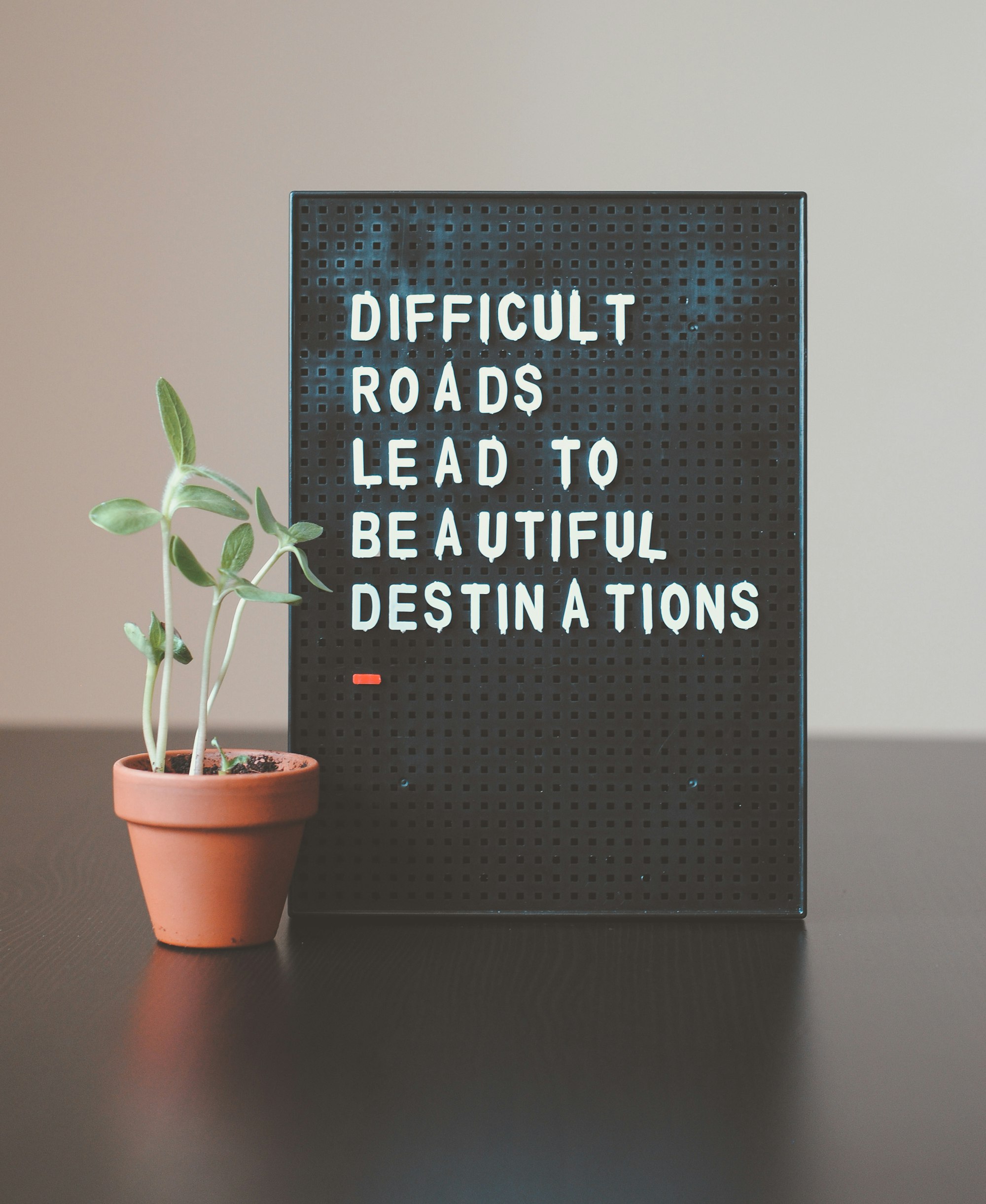
Parents Guide for PURPOSE
Core Ideas about Purpose
Mokuteki 目的 [pronounced moh-koo-teh-kee] are goals, and like every technical term or concept, it's important for students to learn the word and how to say it. (It is, however, perfectly fine to also use the English translation of Goals once the concept has been introduced).
A few important ideas for everyone to understand about Goals:
- Goals are always attached to a Purpose.
- Goals have a specific end-state or objective.
- Goals can be accomplished in a small amount of time, or may take a very long time.
- Goals are made-up of tasks. Tasks are simply things to be done that move the goal forward.
- Some goals have tasks that can be accomplished in parallel.
- Some goals have tasks that must be accomplished in a specific sequence (so-called "sequential goals").
- Goals can also be a mixture of tasks that can be accomplished in parallel and tasks that can be accomplished in a specific sequence.
Here's an example that illustrates these characteristics:
Tasks ::
1. Train at least twice a week.
This is a good example of a parallel task; it will continue, and other tasks are done in parallel with it.
2. Print my syllabus so I can study it.
3. Make flashcards of new concepts and terms.
4. Learn new concepts and terms.
5. Practice my new kata(s).
6. Practice my new techniques.
7. Wait for an Invitation to Rank Test.
8. Attend Rank Test and Succeed!
Goal Accomplished!
Why Goals are Important
If Identity is a compass, and points you in the right direction, and Purpose is the mission that drives you in that general direction and keeps you focused and working hard, then Goals are the specific roadmap that gets you to a specific and clear destination.
In fact, Goals are very specific. They are a step-by-step map that gets to the end-result that you want to achieve. They take into account obstacles that you might encounter along the way, and they help you organize all the resources needed to accomplish that end-result.
The purpose of this exercise – creating a list of goals – is to take the Purposes from previous exercises and turn them into workable plans.
Doing this exercise will teach your young karateka how to create and define a goal and its associated tasks. In point of fact, this exercise is likely the most important of all the exercises in this series: the ability to do this is integral to success in just about anything.
The Exercise
Every student in any kids division – Juniors, Youth, Mentor, and Teens – received Fifteen Goals cards.
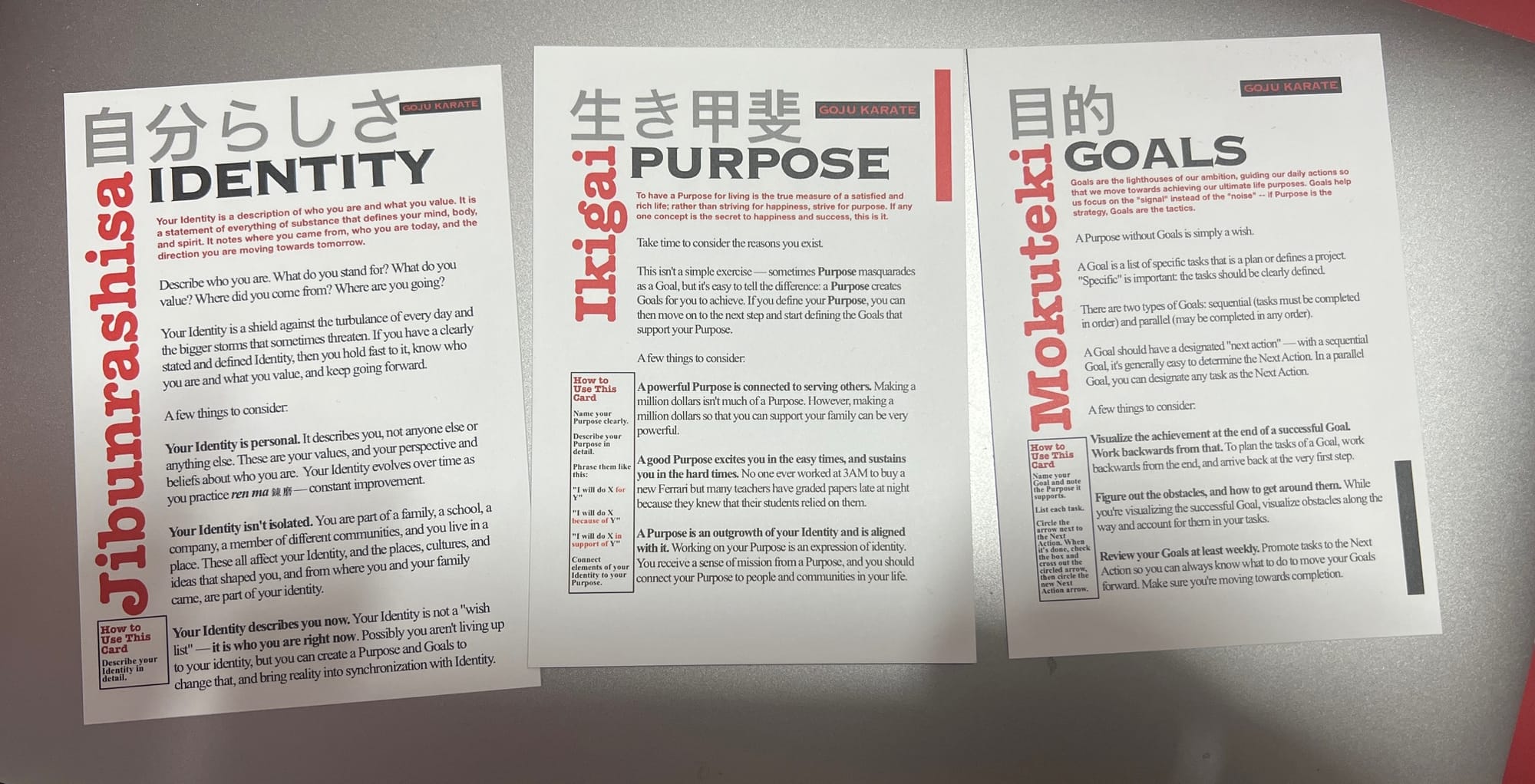
The Goals card has a brief introduction to defining, describing, and writing out a Goal (you have most of this information already, in this article) and the back has a convenient workspace for writing the name of the goal, the purpose to which it belongs, and then a space for making a list of tasks.
It's not entirely necessary to use the cards as the sole place to record and work with Goals. Teens, for instance, may be more comfortable working on a tablet or computer.
However, having an object that is a physical representation of a Goal is very handy for younger kids, and even Adults and Teens benefit from this.
Regardless of age group, spend time talking about the importance of having clearly defined Goals, and discuss the characteristics of a well-crafted Goal and list of Tasks.
How to Define and Build Goals
Click or tap the division below to learn about different plans for writing an Identity statement:
Juniors
Juniors may not have enough writing skills to actually write down a Goal with a description and a list of tasks. So they can follow one or more of these approaches:
1. Write words that represent the Goal. For example, write "karate", "math", "baseball", "learn" etc. Think of this as a "word cloud" of ideas that represent his or her goal.
- Write a few simple sentences: "Become a Blue Belt" etc.
- Talk through the goal with them, and then write out the words so that they can copy them
In addition, talk about the steps (the Tasks) for each Goal. Ask them to close their eyes and visualize what achieving the Goal looks like. In fact, what they see at the end of the goal can become the title for it (e.g., "I see me, wearing a blue belt, at the dojo").
Be sure to have them get the Purpose card that the Goal belongs to, and then copy the name of the associated Purpose onto the Goals card. Use the cards to make the physical connection from their Identity, to their Purposes, to each of the Goals associated with those Purposes.
One of the key points to make: people with Goals accomplish stuff. People without goals, or well-define goals, rarely succeed.
Note: Don't use the arrows ("next actions") field on the cards: they will only add confusion. Encourage young kids to simply check off tasks as they accomplish them.
Youth
Students in the Youth Division should have no problem writing simple sentences.
Have them visualize the end-result of the Goal, and derive the name of the card from what they see. Be sure to have them get the Purpose card that the Goal belongs to, and then write the name of the associated Purpose on the Goals card.
Use the cards to make the physical connection from their Identity, to their Purposes, to each of the Goals associated with those Purposes.
One of the key points to make: people with Goals accomplish stuff. People without goals, or well-defined goals, rarely succeed.
Note: Don't use the arrows ("next actions") field on the cards: they will only add confusion. Encourage young kids to simply check off tasks as they accomplish them.
Mentor
Mentor Division students all can write coherent sentences, but they may need help in focusing on the task at hand to arrive at two to three purposes.
Keep in mind that the entire exercise doesn't have to be completed in one sitting. Perhaps spread it out over a few days, and then each time you resume, review what has already been written.
Have them visualize the end-result of the Goal, and derive the name of the card from what they see. Be sure to have them get the Purpose card that the Goal belongs to, and then write the name of the associated Purpose on the Goals card.
Use the cards to make the physical connection from their Identity, to their Purposes, to each of the Goals associated with those Purposes.
One of the key points to make: people with Goals accomplish stuff. People without goals, or well-defined goals, rarely succeed.
Note: Don't use the arrows ("next actions") field on the cards: they will only add confusion. Encourage kids to simply check off tasks as they accomplish them.
Teens
Spend time discussing all the concepts inherent in Goals and goal planning.
Perhaps spend some time discussing why having Goals is important. Draw parallels to your own life, when you had clear goals and those goals helped you accomplish important things.
Have them visualize the end-result of the Goal, and derive the name of the card from what they see. Be sure to have them get the Purpose card that the Goal belongs to, and then write the name of the associated Purpose on the Goals card.
Use the cards to make the physical connection from their Identity, to their Purposes, to each of the Goals associated with those Purposes.
One of the key points to make: people with Goals accomplish stuff. People without goals, or well-defined goals, rarely succeed.
Also discuss the concept of Next Action (those are the little arrows next to the checkboxes for Tasks). Circle the arrow adjacent to the next Task that should be done, and then put a slash through it when the Task is completed (and circle another arrow on the card to denote the next one).
And negative examples are valuable! Draw comparisons to other teens that they may know that don't seem to have a purpose or a direction -- and don't spend time defining goals and working tasks to accomplish important things.
However, don't be surprised if they'd like to just do this on their own: that's a good thing. As Teens become older and define a sense of their Identity, they will also start to get an idea of what their Purposes can be, and they can define and build goals on their own. This is the beginning of "growing up" -- and that's a wonderful thing. Regardless of this, however, keep the conversation going!
Still, even if they do this exercise on their own, have discussions of Purpose. Talk about some of your Purposes; discuss how the purposes that you have, and they might develop, are also based on the Family's Identity that you all share.
The Next Step
A life lived without Goals (or Purpose, or without a clear sense of Identity) tends to be a chaotic bouncing from one task to another, oftentimes ending in a pile of minor accomplishments that produces little of substance.
It is true that we can have productivity and even accomplishments without clear goals. But what we produce tends to pile up in a disorganized assemblage of tasks finished, yet little of substance actually made.
This set of exercises is therefore not only a very important one, but also teaches a crucial life skill. Once you've done the appropriate exercises with your young Karateka, continue coming back to discussions about Goals, and tasks, and accomplishing those Goals to serve greater Purposes.
Keep this exercise alive by coming back to it over the coming months!