Having a clear statement of Identity is a powerful tool in determining purposes and goals. Working on the exercise of writing an Identity Statement is the first step in seeking self-improvement and achieving goals.
The concept of Identity is a core concept in karatedō and the foundation of other core concepts like ikigai (purpose) and mokuteki (goals).
Together, along with some related concepts, Identity, Purpose, and Goals are part of the Cycle of Four lectures. For some background on that, please see this Parent's Guide.
For a complete discussion of Jibunrashisa 自分らしさ, please read this article in preparation of working through the exercises we'll discuss below.
 Goju Karate
The full background of the concept of Identity.
Core Ideas about Identity
Jibunrashisa 自分らしさ is pronounced “jee-bun rah-sh-ee-sa” and like every technical term or concept, it's important for students to learn the word and how to say it. (It is, however, perfectly fine to also use the English translation of Identity once the concept has been introduced).
A few important ideas for everyone to understand about Identity:
- Identity is about who you are RIGHT NOW.
- Identity is expressed in the form of "I am _______"
- Identity statements should be short and concise.
- Identity statements should encompass every element of identity possible.
Here's an example that illustrates these characteristics:
I am a boy that is strong and runs fast. I am tall.
I am smart and I am good at writing and drawing. My favorite subjects in school are science and math.
I am a yellow belt in karate.
I like to build things with Lego and with other toys.
I like watching videos about history. I like to read books and I also like to read comic books. My favorite character is Batman. I also like to tell my own stories and make up my own characters.
I live in New York City and I like walking to school and to the dojo and to the park
I like all types of food but my favorite is pizza.
Why Identity is Important
Everyone thinks that they know their own identity. Most adults actually don't have a clear vision of their identity, and most kids haven't been exposed to this concept and its importance.
The purpose of this exercise – creating an identity statement – is to build a foundation that purposes and goals can stand upon. The exercise of discussing identity can be quite eye-opening for parents: you may discover some things about your son or daughter that you didn't know!
But even more importantly, doing this exercise will give your young karateka a sense of themselves that is clear and that they can understand. This is a very valuable thing to have.
The Exercise
Every student in any kids division – Juniors, Youth, Mentor, and Teens – received an Identity card. (In subsequent weeks, they'll receive several Purpose cards, and even more Goal cards.)
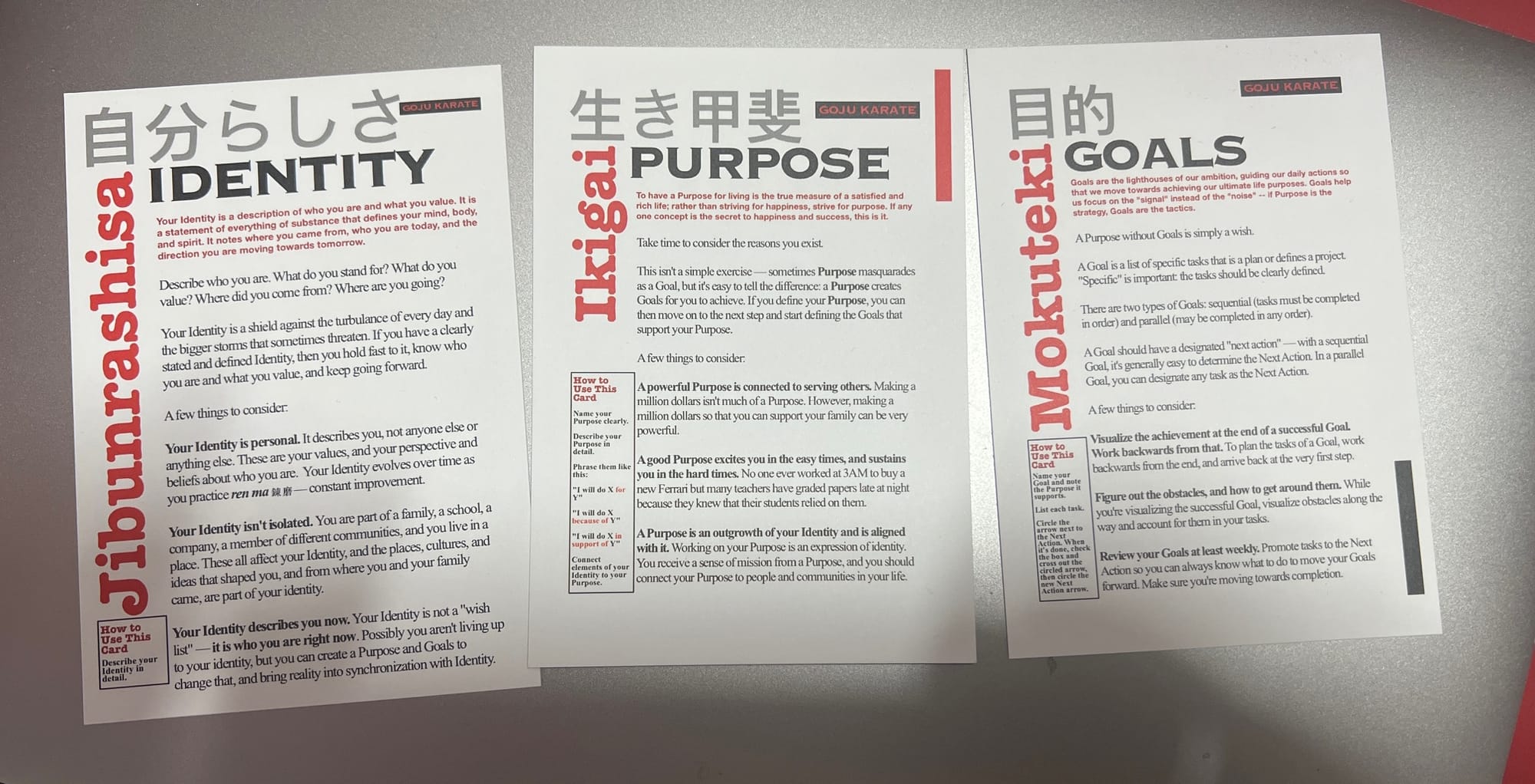
The Identity card has a brief introduction to creating an Identity Statement (you have most of this information already, in this article) and the back has a convenient workspace for writing it.
It's not entirely necessary to use the cards as the sole place that an Identity statement lives. Teens, for instance, may be more comfortable working on a tablet or computer.
However, having an object that is a physical representation of Identity is very handy for younger kids, and even Adults and Teens benefit from this.
Regardless of age group, spend time talking about the importance of having a strong sense of Identity, and what the characteristics are of an Identity statement.
How to Write the Identity Statement
Click or tap the division below to learn about different plans for writing an Identity statement:
Juniors
Juniors may not have enough writing skills to actually write a full Identity statement, even a simple one. So they can follow one or more of these approaches:
1. Write words that represent the concepts. For example, write "strong", "smart", "math", "karate", "tell stories", "Batman" etc. Think of this as a "word cloud" of ideas that represent his or her identity.
- Write a few simple sentences: "I am smart" etc.
- Draw a picture of themselves, with perhaps a word or two around the picture.
Youth
Students in the Youth Division should have no problem writing simple sentences. Treat the exercise as a series of bullet-points, and structure each sentence in the form of "I am ___________"
Write as many of these bullet points as possible.
Mentor
Mentor Division students all can write coherent sentences, but they may need help in focusing on the task at hand to arrive at a usable Identity statement.
Keep in mind that the entire exercise doesn't have to be completed in one sitting. Perhaps spread it out over a few days, and then each time you resume, review what has already been written.
Other than focus, Mentor kids will produce fine Identity statements: they've been doing meditation exercises for several weeks preparing them.
Teens
Spend time discussing all the concepts inherent in Identity. Perhaps spend some time discussing specific identity traits that your Teen might value.
However, don't be surprised if they'd like to just do this on their own: that's a good thing. One of the big challenges, and big accomplishments, of Teen maturity is evolving a strong sense of Identity that isn't an extension of Mom and Dad. Encourage this!
The Next Step
The purpose of writing an Identity Statement is two-fold: to prepare the ground for the upcoming exercise in defining Purpose; and to have a reference that can be consulted and is visible throughout the coming year.
That last point is very important: over the coming months, refer back to this exercise and its outcome. Was the Identity statement a good one? Have aspects of it changed? Has it been a valuable reminder of who your son or daughter is?
Remember that an Identity statement can be a compass, indicating a general direction. It can keep one on course, moving in the right general direction. If a part of a child's identity is "I am good at Math." then perhaps doing more math activities makes sense. If "I love to read." is a part of Identity, then find more books to read and making time for reading is called for.
Identity is also a shield: if a lot of time is spent during the week doing things that aren't in congruence with Identity, then perhaps it's time to rethink the week's schedule. A strong and well-constructed Identity statement can protect one's identity as much as it can empower it.
This isn't a static exercise done once, and then discarded. Rather, it is the beginning of creating a valuable roadmap forward. Keep this exercise alive by coming back to it over the coming months!